
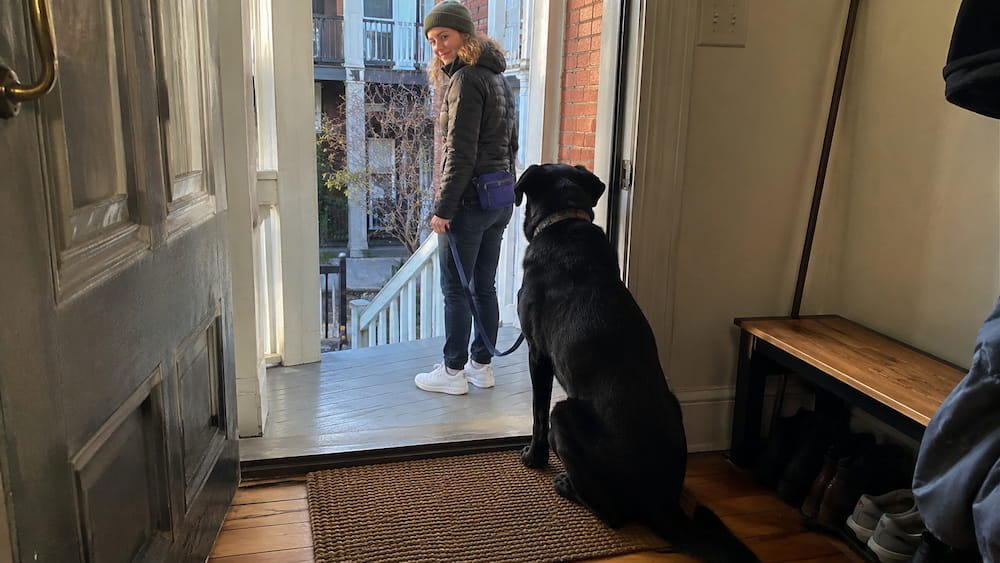
The doorbell rings, and the peace of your apartment detonates. Before the chime even finishes, your dog is off the couch and airborne, barking in that cracked, frantic register, skidding across the floor of your Somerville triple-decker and slamming into the door hard enough to rattle it. You're shouting over the noise, trying to hook a finger under the collar, and by the time you actually get the door open — sweaty, apologizing — your friend is standing on the stoop wondering if it's safe to come in. You love this dog. You just wish the doorbell didn't turn him into a car alarm.
If that scene plays out every time someone knocks, a delivery lands, or a neighbor's buzzer goes off through the wall, you are not living with a bad dog. You're living with a dog who has learned that the doorbell is the single most exciting event of the day, and who has no idea what to do about it except everything at once. The good news is that "calm at the door" is a skill you can teach, the same way you'd teach a sit. This post is about the sound and the frenzy — the barking, the charging, the spin. If your dog's main crime is the actual jumping up on the guest once they're inside, we covered that step by step in a separate post; here we're fixing the meltdown that happens before anyone is even through the door.
You're trying to argue with a slot machine that hits the jackpot every time.
Why the doorbell sets him off
Nothing about a doorbell is naturally exciting. It's a two-note chime. What makes your dog lose his mind is everything that has ever followed it: you jumping up, footsteps, the door opening, a person appearing, sometimes the best thing in the world walking in. Your dog has heard that chime hundreds of times and every single time, something happened. So the doorbell stopped being a sound and became a starting gun — a reliable predictor that the biggest event of the day is one second away.
Then the barking gets its own paycheck. Your dog barks, and — from his point of view — it works: you appear, the door opens, the visitor arrives. He can't know the guest was coming anyway. All he knows is that barking at the door has a perfect track record of making exciting things happen. Add the fact that a good hard bark feels good to a wound-up dog, and you have a behavior that pays out on every level. This is why "quiet" shouted across the room does nothing. You're trying to argue with a slot machine that hits the jackpot every time.
The fix is not to suppress the noise. It's to change what the doorbell means and to give your dog a specific, rewarding job to do the instant it rings — one job that is physically incompatible with charging the door.
Give the doorbell a new answer: "go to your place"
The most reliable thing you can teach a door-frantic dog is a station — a mat, a bed, or a specific spot a few feet back from the door, far enough that a swung-open door won't hit it but close enough that your dog still feels included. The goal is a dog who hears the bell and goes to the mat and lies down, because over hundreds of reps that has become the thing that pays. A dog on a mat cannot also be body-slamming the door. You're not asking him to be quiet by willpower; you're handing him a better move.
Build the mat first, with no doorbell anywhere near it:
Make the mat a slot machine.Put the bed down, and any time your dog steps onto it, calmly mark the moment and drop a treat right on the mat. Say nothing else. He steps off, nothing happens; he steps on, food appears. Most dogs start deliberately parking themselves on the mat within a session, testing whether it still works. It does.
Pay the down, and pay duration.Once he's offering the mat, wait for him to lie down and pay that more richly. Then start feeding a slow trickle while he stays — one treat every couple of seconds for doing nothing. You're teaching that the mat is where calm gets paid, on repeat.
Add a word.When he's heading to the mat reliably, name it — "place," or "bed," or "spot," whatever you'll remember under pressure. Now you have a cue that means one thing: go there and settle.
Spend a few days here, in a quiet room, before the door is ever involved. A mat behavior that only works in the calm of your living room won't survive a real knock — but it's the foundation everything else bolts onto.
Defuse the sound itself
While the mat is getting solid, work on the doorbell separately so the chime stops being a starting gun. Ring your own bell, or play a recording of it, at a low, boring volume — then immediately scatter a little food on the mat. Bell, then food on the spot. Bell, then food on the spot. You're not asking for anything yet; you're just rewiring the association so the sound starts to predict "good things happen over on the bed" instead of "launch at the door."
Do this ten or fifteen times a session, keeping your dog under the point where he tips into full frenzy. If one ring sends him over the edge, it's too loud or too realistic — turn it down, muffle it, or ring it from another room, and build up. Over a week or two the chime quietly loses its charge. Plenty of owners find their dog eventually hears the bell and trots to the mat on his own, looking expectantly at the treat jar, before they've said a word.
Put it together: bell, mat, settle, then greet
Now you chain the pieces. Ring the bell, cue "place," and pay generously the instant your dog lands on the mat and lies down. Walk to the door, touch the handle, and if he holds the mat, pay again. Open the door to an empty hallway, pay. Close it, release him with a word, big warm party. You're rehearsing the entire sequence — the sound, the station, the settle, the calm release — over and over with no real guest in sight, so that when a real one shows up, your dog is running a script he already knows cold.
When you add a person, drop your standard for a rep or two and make it easy. A calm, briefed household member is the ideal first "guest." Have them ring and wait outside while you cue the mat and pay heavily for the down. Only open the door once your dog is settled, and reset to the mat every time he pops up. The visitor stays boring until you release your dog to say hello. This is the same steady calm you'd build for a walk — a settled dog in an easy setup beats a wired one in a hard one, every time.
Manage the door while you're still teaching it
Training takes a few weeks; your doorbell will ring tomorrow. So run management in parallel so your dog can't keep rehearsing the meltdown between practice sessions. A baby gate across the hall, a leash clipped to a heavy piece of furniture near the mat, or simply tucking the dog behind a door when you know a delivery is coming — none of these are punishments. They're seatbelts. Every frenzy that doesn't happen is a rep of the old habit fading a little.
A few things quietly make it worse, so watch for them:
Yelling "quiet" into the storm.To your dog, your raised voice is just you joining the alarm. It adds energy; it doesn't remove it.
Only ever practicing on real guests.Real arrivals are far too exciting to learn on. Do ninety percent of your reps on your own bell with nobody there.
Letting the doorbell keep paying the bark.If barking still reliably produces an open door and a visitor, the habit stays fed. Management breaks that link while the mat replaces it.
Skipping the calm before the greeting.Opening the door mid-bark tells your dog the barking worked. Wait for even one beat of quiet, or a settle on the mat, before the door moves.
Troubleshooting
He goes to the mat but won't stop barking.Start by paying the mat itself, barking and all — the position is the first win. Then hold your treat delivery for the tiny gaps of quiet and feed into them. The barking shrinks as the quiet becomes the thing that pays.
He holds the mat for me but blows it the second the door opens.The door is a bigger trigger than the bell. Split it finer: reward just touching the handle, then just the handle turning, then a one-inch crack, building the open in slices over several sessions.
He's perfect until a real person is actually there.A live guest is a different universe of exciting. Go back to a calm briefed helper, keep the leash-anchor on so a failed rep can't become a charge, and pay lavishly for calm at a distance before you close the gap.
The barking spikes right when I start ignoring it.That's an extinction burst — the behavior tries harder right before it fades because it used to work. Hold the line, stay boring, pay the first calm second, and it drops off within a few reps.
Where to practice in Cambridge and Somerville
The door itself is the exam; most of your studying happens in calmer places first. Build the mat and the settle where it's easy, then borrow real-world commotion to proof it.
Easy — your own living room and hallway.The mat drills and your own-bell reps belong here, on a quiet weekday. The shared entryways of a Somerville triple-decker, with their buzzers and stairwell footsteps, are a perfect middle step once the basics hold.
Medium — a bench at Powder House Park or the edge of Danehy Park.Bring the mat, cue a settle, and pay calm while ordinary foot traffic passes at a workable distance. You're teaching "people appearing doesn't mean go off."
Medium-plus — a quiet corner of Cambridge Common or off the Minuteman Bikeway near Alewife.More movement, more strangers, still enough room to reset before your dog is over threshold.
Advanced — a Davis Square patio on a slow afternoon.Save this for when the settle is genuinely solid. A dog who can hold a relaxed down while the world walks by here will hold it through a doorbell at home.
Everywhere you practice, you're teaching one idea: excitement arrives, and the answer is to settle and be paid — the same message the doorbell will eventually carry.
When to bring in help
Most dogs learn a calm door in a few weeks of honest, boring reps. Some make it genuinely hard — big dogs whose charge is a safety problem, adolescents in the peak of their over-the-top phase, rescues who arrived already convinced the doorbell is a threat, or dogs whose door frenzy is tangled up with real anxiety or barking that spills into every hallway noise. Those cases are where an experienced set of eyes on your actual door, with your actual dog, saves you weeks of guessing which piece to fix first.
Good Dog Boston trains in your home and at your own front door, using reward-based methods as our primary approach. We take on the dogs plenty of places turn away, and we have Spanish-speaking trainers available. If you've started flinching every time the bell rings, a trainer coaching you through a real arrival on your own doorstep is worth more than any amount of reading.
If you'd like a hand, book a free evaluation call and we'll talk through what's going on and where to start. No pressure, no pitch — just a plan.
Contamos con entrenadores hispanohablantes.
Struggling with this at home?
Every dog is different, and some problems are hard to solve from a blog post. Tell us what is going on and we will talk through where to start — free, no pressure, no pitch.