
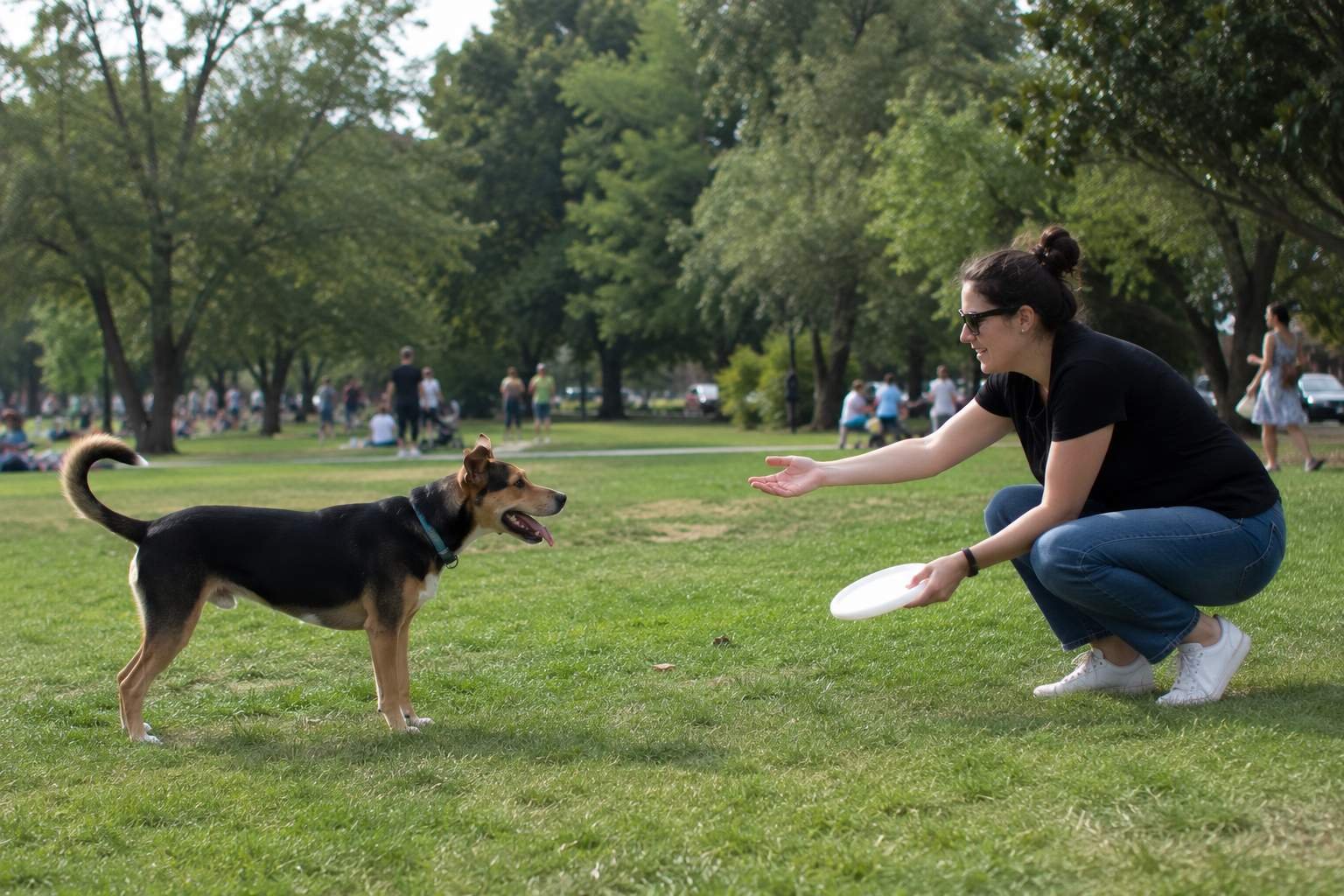
You're at the edge of Danehy Park and the leash is off for two happy minutes when it happens. Another dog appears across the field, or a squirrel breaks for the tree line, and your dog is gone — nose down, ears flat, already forty feet away and closing. You call their name. Nothing. You call it again, higher, and hear the note of panic creep into your own voice. You start walking, then half-jogging, then doing the thing you swore you'd never do: chasing your own dog across a public park while they treat the whole thing as the best game of the day. If you've lived that moment, you already know recall isn't a nice-to-have.
In a city like Boston — with bike paths, busy streets a short dash away, and a dog park's worth of distractions on every green space — a dog who comes when called is a dog who stays safe. The good news is that recall is a trainable skill, not a personality trait, and the method is simpler than most people think. Here's how to build one that holds up when it counts.
Why "come" usually fails
Most dogs don't ignore recall because they're stubborn. They ignore it because, from their point of view, coming back has been a bad deal. Think about what "come" usually predicts. It predicts the leash going back on, the fun ending, the walk being over, or — worst of all — being told off for not coming sooner. If the word "come" reliably means "the good part stops now," your dog is doing the sensible thing by ignoring it. They're weighing the squirrel against a clipped leash and a flat tone, and the squirrel wins every time.
So the whole game is this: make coming back the best bet on the field. Every single time your dog hears the recall word, something genuinely great should happen — better than whatever they left behind. This is classical conditioning doing the quiet work: the word itself starts to mean "brilliant things happen at my person's feet," and the dog turns before they've even thought about it. We're not begging the dog to obey. We're building a reflex. One rule underpins all of it: never punish a dog who comes to you, ever — even if they took the scenic route and ignored you for a full minute first. The instant you're angry when they arrive, you've taught them that arriving is the mistake. Pay them for showing up, no matter how late. You can fix the delay later; you can't un-teach "coming back gets me in trouble" easily.
Pick a fresh word and load it up
Your dog's name is worn out. So is "come" if you've been saying it into the void for a year. Pick a brand-new recall cue with no baggage — "here," "to me," or a short whistle all work well. This word is now sacred: it only ever gets used when you can back it up, and it never gets wasted on a situation you can't win. Start by simply pairing the word with food, indoors, with zero challenge. Say "here" in a bright voice and immediately feed your dog a small, high-value treat — real chicken, cheese, something they'd cross the room for, not dry kibble. You're not asking them to do anything yet. You're just teaching their brain that this new sound predicts something excellent. Do a dozen reps over a couple of days until the word alone makes their head snap around. That head-snap is the foundation. Everything else is built on it.
Build the recall in small, winnable steps
Once the word means "good things," you start adding distance and difficulty — always at a level where your dog can succeed, then a little more.
The runaway game, indoors. Toss a treat a few feet away. As your dog trots off to eat it, say "here" in a happy voice and take a step or two backward. When they turn and come, mark it ("yes") and pay generously right at your legs. Backing away turns recall into a chase toward you, which dogs love. Repeat down a hallway.
Add a person and a game of ping-pong. Two people, ten feet apart, take turns calling the dog back and forth — "here," pay, then the other person calls. The dog learns that coming is a fun, repeatable, always-paid game, not a one-off command.
Move to the yard or a quiet fenced space, on a long line. A 15- or 30-foot training lead lets you practice at real distance without risking a bolt. Let your dog wander and sniff, then call once — "here" — and reel gently as you pay them for turning toward you. The long line is a safety net, not a steering wheel. You're not dragging them in; you're making sure the word never gets tested when you can't win.
Practice the leash-on "gotcha." Half the reason dogs dodge the final grab is that the reaching hand means the fun is over. So practice reaching for the collar and feeding at the same time, then letting them go again. Clip the leash on, pay, unclip, keep playing. Now the leash and the collar-grab stop predicting "walk's over" and start predicting "treat, then more freedom."
Only then add distraction — one notch at a time. A quiet park at 7am is easier than the same park at 5pm. Another dog at a hundred feet is easier than one at twenty. Add difficulty gradually, and if your dog blows the recall, you've jumped too far up the ladder — go back to an easier level and rebuild. A recall that works at low distraction is a real thing you can grow, not a failure.
Keep the paycheck unpredictable
Once your dog is coming reliably, don't drop the rewards cold — fade them the smart way. Move to paying at random: sometimes one treat, sometimes a jackpot of five for a fast return, sometimes a thrown ball or a tug game instead of food. Unpredictable, occasional payoffs actually build a stronger habit than a treat every single time — it's the same principle that keeps people feeding slot machines. Your dog never knows which recall pays big, so every one is worth doing. Mix in life rewards, too. Call your dog, pay, and then release them straight back to the sniffing or the play they wanted. Now "here" doesn't even reliably end the fun — sometimes it's just a quick check-in on the way to more freedom. That's the recall that holds up.
What to do when it falls apart
They come 90% of the time, then blow you off near other dogs.
That's a distraction threshold, not defiance — your dog is over their limit and can't hear you. Back up to more distance and lower stakes, and put the long line back on for a while. If the trigger is another dog and it tips into barking or lunging, that's leash-reactivity, and it needs its own approach.
They come, but slowly, sniffing the whole way.
Make yourself more exciting than the ground: run backward as they come, use a squeakier voice, throw a jackpot when they speed up.
Pay the fast returns far better than the slow ones: It works with treats and falls apart without them.
You faded the food too fast, or the reward stopped being worth more than the distraction: Go back to high-value pay for a while and build the unpredictable-jackpot habit before thinning it out again.
They bolt the second the leash comes off.
Don't practice off-leash yet. Live on the long line until the recall is a reflex — off-leash freedom is something a dog earns, not a place you start.
Where to practice in Cambridge and Somerville
Recall is all about matching the distraction to your dog's level, so pick your spot on purpose and build up. Note that off-leash rules vary by park and by hour — check current signage, and use a long line anywhere off-leash isn't clearly allowed.
Easy — your hallway, yard, or a quiet dead-end street.
Start where there is almost nothing to compete with you. The calmer side streets off Massachusetts Ave early on a weekday are plenty.
Medium — the Somerville Community Path or Alewife Brook Reservation, on a long line.
Wide, predictable, and you can create distance from other walkers when you need it.
Medium-plus — Nunziato Field or the open stretches at Danehy Park, off-peak.
Big grassy room to practice distance recalls, but go at a quiet hour first and keep the long line on until it's solid. -
Advanced — the Charles River Esplanade or Fresh Pond loop on a nice day.
Save these for when the recall is genuinely reliable. If your dog turns on a dime here, with bikes and dogs and joggers everywhere, they'll turn anywhere. Work at the edge of what your dog can handle, not past it. The same slack-leash walk principle applies here: a calm ten minutes in an easy spot beats a chaotic hour somewhere too hard, and it keeps the recall winning.
When to bring in help
Some dogs build a bombproof recall in a few weeks of steady practice. Others — high-drive dogs, adolescents in the "selective hearing" stage, sighthounds and scent hounds wired to chase, or dogs whose bolting is tangled up with anxiety — need an experienced set of eyes to get the plan and the timing right for that specific dog. That's what we do. Good Dog Boston trains in your home and on your actual routes, using reward-based methods. We take on the dogs plenty of places turn away, and we have Spanish-speaking trainers available. If the off-leash minutes have become the part of the walk you dread, a trainer watching *your* dog on *your* field can save you weeks of guessing. If you'd like a hand, book a free evaluation call and we'll talk through what's going on and where to start. No pressure, no pitch — just a plan.
Struggling with this at home?
Every dog is different, and some problems are hard to solve from a blog post. Tell us what is going on and we will talk through where to start — free, no pressure, no pitch.