
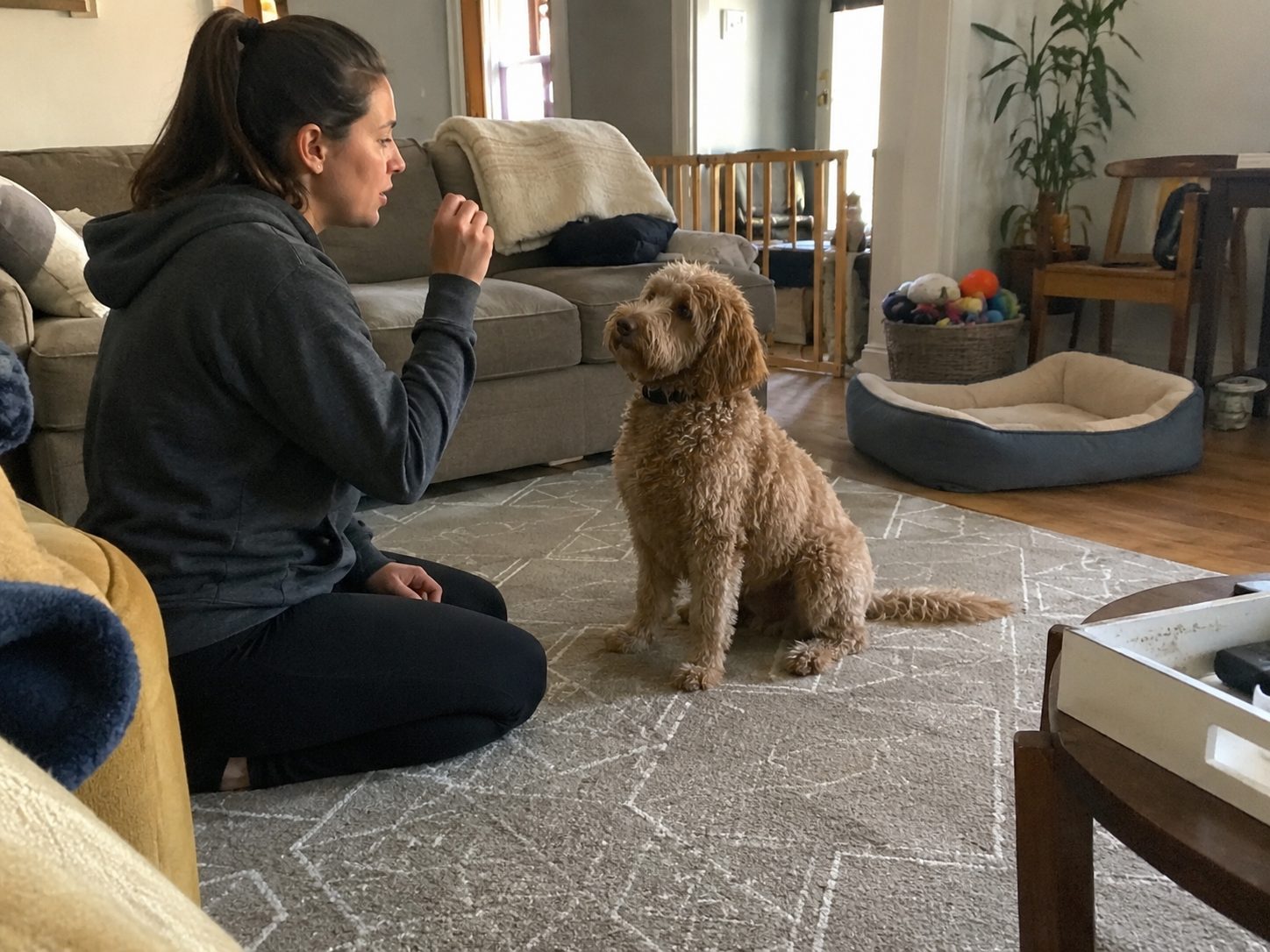
It's the first night. There's a new puppy — or a newly adopted rescue — in your apartment, and there's a crate in the corner that the shelter or the breeder told you to use. You put your dog inside, close the door, turn off the light, and lie in bed listening to him cry. The walls are thin. The neighbor below you gets up at six. Every whine feels like it's echoing down the whole stairwell, and by two in the morning you're wondering whether the humane thing is just to give up, open the door, and let him sleep on your chest. You feel like a jailer.
Here's the reframe that changes everything: a crate, done right, is not a cage you shut your dog into. It's a den you teach him to love — a small, safe room that's his, in a home that can otherwise feel loud and overwhelming, especially in a dense city apartment. A dog who's properly crate trained doesn't tolerate the crate; he chooses it. He wanders in on his own to nap. He settles when the door's open. Get there and the crate stops being a nightly battle and becomes one of the most useful things you own — for house-training, for calm, for safe travel, and for those hours you have to be out. This post is how you get there, without the crying nights, using reward-based methods and a bit of patience.
A crate, done right, is not a cage you shut your dog into — it's a den you teach him to love.
Why the crate is a kindness, not a punishment
Dogs are den animals by wiring. A small, enclosed, covered space isn't confinement to them — it's security. Left to their own devices, a lot of dogs will seek out a spot under a table or behind a couch precisely because the walls at their back feel safe. The crate gives them that on purpose, in a spot you've chosen.
That matters double in a city apartment. Your dog has no yard to drift out into, no back room to retreat to, and a firehose of sound coming through the walls — footsteps overhead, the buzzer, garbage trucks, the couple next door. A dog with a den has somewhere to be when the world is too much. A dog without one has to manage all of it, all the time, which is exactly the recipe for a restless, wound-up dog who can't switch off.
The crate is also the single most useful house-training tool there is, because dogs won't usually soil where they sleep. And it keeps a young dog — or a nervous rescue who chews when stressed — safe from the apartment while you're out, instead of loose with your baseboards and your charging cables. None of that works, though, if the dog is afraid of the box. So the whole game is this: the crate has to become a good place, never a bad one. Everything below is in service of that one idea.
Pick the right crate, and the right corner
Two quick setup calls make the rest easier.
Size it snug, not spacious. The crate should be just big enough for your dog to stand up, turn around, and lie down comfortably — no more. It's tempting in a small apartment to buy one crate for a puppy's adult size and be done, but a crate the dog can toilet in one end and sleep in the other quietly defeats the house-training benefit. If you're buying for a puppy who'll grow, get a crate with a divider panel so you can shrink the usable space now and open it up later.
Put it where the family actually is. The worst place for a crate is banished into a spare room or a dark hallway, because a den in exile teaches your dog that going in means being cut off from everyone. In a studio or a one-bedroom you don't have many options, and that's fine — the corner of the living room or a spot at the edge of the bedroom both work. Draping a blanket over three sides to make it cave-like helps a lot, especially in an open-plan apartment where there's nowhere truly quiet.
Step 1: make the crate the best real estate in the apartment
Start with the door off or propped fully open, and simply make good things happen in and around the crate.
Feed the whole idea with food. Toss a few treats just inside the door and let your dog walk in to get them, in his own time — no luring him in and slamming the door, no pushing. If he'll only put his head in at first, pay that. The message you're building, one treat at a time, is "the crate is where snacks come from."
Move his meals to the doorway, then inside. Put his food bowl at the crate's opening, then a little further in over a few days, until he's eating his whole dinner standing inside with the door open. A dog who eats his meals in the crate has already decided it's his.
Leave the door open and let him choose. Drop a special chew or a stuffed toy in there and just leave it. Toss the odd treat in when he's not looking, so he learns to wander over and check because good things sometimes appear. You want to catch him going in on his own — that's the whole win. When he does, mark it quietly and pay it.
Spend a couple of days right here, door never closing, until walking into the crate is boring and obvious to him. Rush this part and everything after it gets harder.
Step 2: close the door on calm, not on panic
Once your dog strolls in happily, start closing the door — briefly at first, while something good is happening. Give him a stuffed food toy or a long-lasting chew, close the door while he's working on it, and stay right there. After a few seconds, open the door again — before he's finished, before he's worried. Build the time up in small steps: ten seconds, thirty, a minute, a few minutes, always while he has something good to do in there. A frozen stuffed toy is your best friend here; it turns crate time into the best part of his day and teaches his body to relax inside with the door shut.
Then start adding distance. Close the door, take one step away, step back, open. Then two steps. Then out of sight to the kitchen for five seconds and back. You're teaching two things at once — the door closing is nothing to fear, and you leaving the room means you'll return. Keep every rep easy enough that he stays relaxed. If he starts to fret, you've gone too far too fast; shrink the difficulty and build back up. Calm is what you're rewarding, so calm is what you have to give him the chance to do.
Step 3: the first departures and the first nights
Real absences and bedtime are just longer versions of what you've already built — but they're where city apartments throw their curveballs, so treat them gently. For departures, don't make a production of leaving or coming home. A big teary goodbye and an ecstatic reunion teach your dog that your absence is a huge deal, which is the opposite of what you want. Settle him in the crate with a good chew, leave quietly, and come back quietly. Start with short trips — around the block, a coffee run — and build up. A dog who's had a proper walk first will settle far more easily than one you've crated with a full tank of energy.
For the first nights, put the crate where you can hear him, ideally in or near the bedroom to start. A puppy who wakes at three usually needs to toilet, not to be ignored — take him out on-leash, calm and boring, straight back to the crate after, no play. A little crying as he settles is normal and fades over a few nights as the crate becomes familiar. Frantic, escalating panic is different, and that's a sign to slow the whole process down, not push through it.
Apartment realities in Somerville and Brookline
Crate training a dog in a dense apartment isn't the same job as doing it in a house with a yard, and it's worth naming the parts that are genuinely harder here.
The neighbors can hear everything. In a Somerville walk-up or a Brookline apartment building, a crying puppy at midnight isn't just your problem. This is the real reason not to shortcut the steps above: a dog who genuinely loves his crate is quiet in it. Draping the crate to make it den-like, a frozen chew at bedtime, and building duration slowly are what buy you — and the person on the other side of the wall — a peaceful night.
There's no yard for the potty step. House-training leans on the crate keeping your dog clean between trips outside, but "outside" is a flight of stairs and a leash away, not a back door. Get ahead of it: take a young dog out on a tight schedule — first thing, after meals, after naps, before bed — and go with him rather than trusting a yard to do the job.
Winter makes the walk-up harder. From December to March, "just take him out" means boots, a coat, and three flights of stairs at 2 a.m. Plan for it. A reliable overnight routine built in the fall pays off enormously when it's ten degrees out and you'd rather not be arguing with a puppy on the landing.
Small square footage cuts both ways. You're never far from the crate in a one-bedroom, which makes the "leave the room and come back" reps easy to fit in. Use that — you can run ten short crate reps in an evening without going anywhere.
Where a crate-trained dog pays off everywhere else
A dog who's genuinely comfortable in his crate is easier to live with far beyond the crate itself, because you've built him something most city dogs never get: a real off switch and a place to use it. The crate is a close cousin of a real off switch on a mat — both teach your dog that settling in one spot, on his own, is a rewarding thing to do rather than something you have to enforce.
It also gives him somewhere to be when the apartment gets loud. If the buzzer sends him into orbit every time a delivery arrives, a dog who'll go to his crate has a job that isn't losing his mind at the door. And a dog who's a springboard the moment guests arrive can be settled calmly in his den while everyone gets their coats off, then let out into a calmer room. The crate quietly makes a dozen other things easier.
What quietly sabotages crate training
Using the crate as punishment. The instant the crate becomes where the dog gets sent when he's in trouble, it stops being a den and becomes a penalty box. Never crate an angry "go to your crate." Keep it a place good things happen.
Too much crate, too fast. A dog isn't ready for eight hours in the crate on day two. Long stretches before he's comfortable teach him the crate means being trapped and alone. Build up.
A crate that's too big. Give a puppy a suite and he'll toilet in one corner and sleep in the other, and you've lost the house-training benefit. Size it snug or use a divider.
Crating a dog who hasn't been exercised. Stillness isn't the same as tiredness. A dog crated with a full tank will fight it; a dog who's had a real sniffy walk usually settles and sleeps.
Rushing the door closing. Slamming the door before the dog loves the open crate is the single most common way to create a dog who panics at the sight of it. Let the open crate get boring first.
Troubleshooting
He cries the moment I close the door. You closed it before the open crate was truly comfortable, or you built duration too fast. Go back to door-open games and closing it for just a second or two while he's eating a chew, and stretch the time in smaller steps.
He won't go in at all. Don't force or lure him in and trap him. Go slower: feed every meal at the doorway, toss treats just inside, and let choosing to enter be the whole exercise for a few days before the door ever closes.
He soils the crate. Usually the crate's too big, or he's being left longer than his bladder can manage — very common with young puppies. Shrink the space with a divider and tighten the potty schedule so he's out more often.
He was fine, then suddenly hates it. Something scared him in there, or a stretch got too long. Back up several steps to easy, good reps and rebuild the good association before asking for duration again.
He panics — real, frantic distress, not settling grumbles. That can be more than crate discomfort; some dogs, especially rescues, carry genuine anxiety about being confined or alone. Don't push through panic. Ease right off and, if it doesn't shift, get eyes on it.
When to bring in help
Plenty of dogs learn to love a crate in a couple of weeks of easy, boring reps. Some make it genuinely hard — puppies who scream the building awake, rescues who were never taught that a small space can be safe rather than a trap, dogs whose crate trouble is tangled up with real separation anxiety rather than simple unfamiliarity. Those are the cases where an experienced set of eyes on your dog, in your actual apartment, saves you weeks of guessing which piece to fix first — and saves your neighbors some sleep.
Good Dog Boston trains in your home, in the exact apartment where your dog is struggling, using reward-based methods as our primary approach. We take on the dogs plenty of places turn away, and we have Spanish-speaking trainers available. If you're worn down by a puppy who won't settle at night, or a rescue who falls apart the moment the crate door closes, having a trainer build the crate up with you — in your own space, on your own schedule — is worth more than any amount of reading.
If you'd like a hand, book a free evaluation call and we'll talk through what's going on and where to start. No pressure, no pitch — just a plan.
Struggling with this at home?
Every dog is different, and some problems are hard to solve from a blog post. Tell us what is going on and we will talk through where to start — free, no pressure, no pitch.