
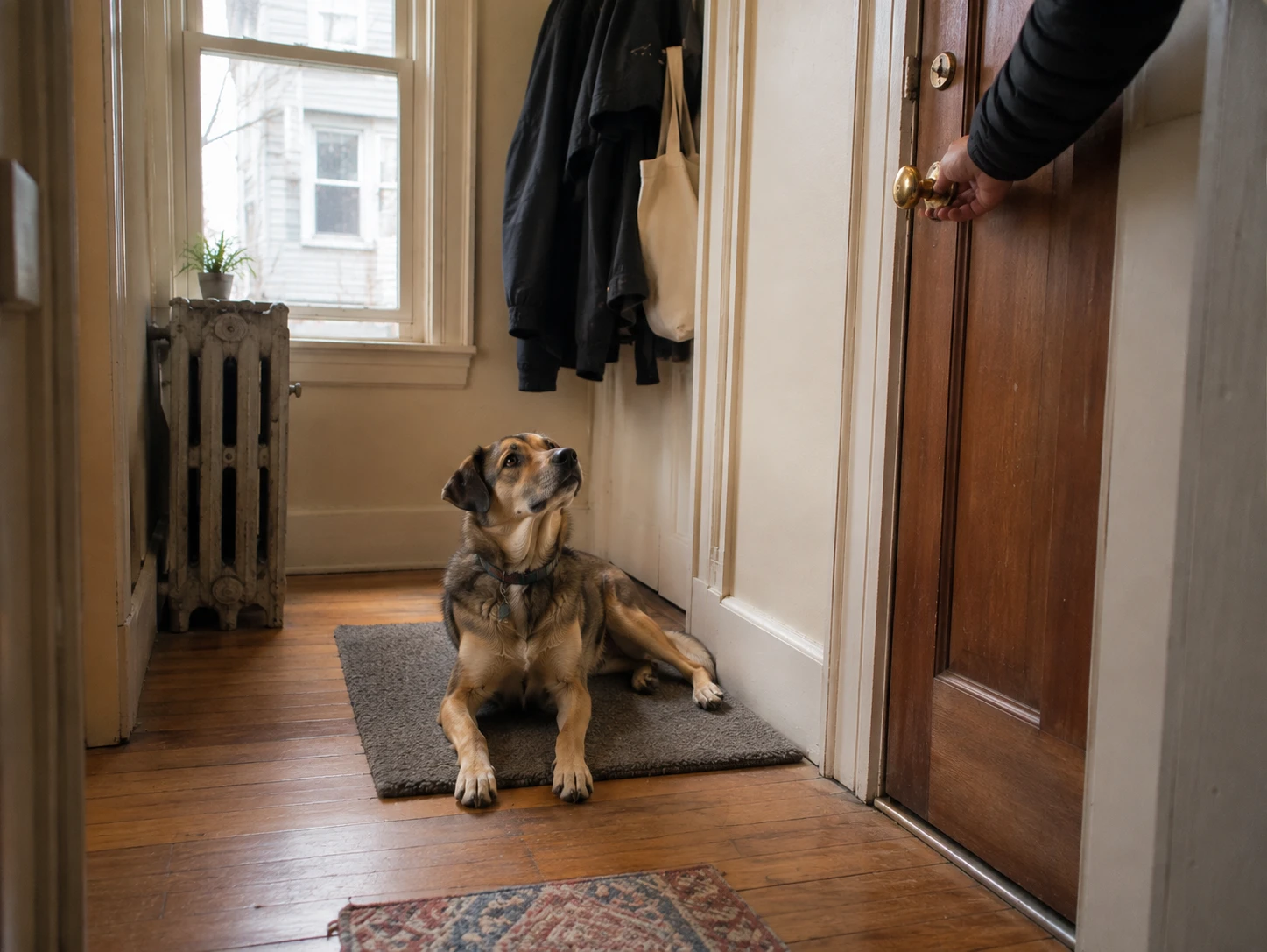
You get home and your stomach drops before you even open the door. There's a note taped to it, or a text already waiting on your phone: the barking again. Inside, you find the evidence — a chewed door frame, a puddle by the entry from a dog who is otherwise perfectly house-trained, claw marks on the window sill. And there's your dog, frantic with relief, as if you'd been gone for a year instead of an afternoon. You feel guilty, you feel trapped, and somewhere underneath it you feel a little resentful, and then guilty about that too.
If this is you, take a breath. Your dog is not being spiteful, he is not punishing you for leaving, and you have not "spoiled" him into this. Separation anxiety is a genuine panic response — closer to a human panic attack than to bad manners — and it is one of the most misunderstood problems a dog can have. The good news is that it responds beautifully to patient, reward-based work, and you do not need to frighten or punish your dog to fix it. This post is how a Boston trainer actually approaches it, step by step.
Separation anxiety isn't misbehavior. It's panic — and you can't punish a dog out of a panic attack any more than you could a person.
Which means the whole plan is about safety and trust, not correction.
First: is it really separation anxiety?
Not every mess or noise while you're out is anxiety, and this distinction matters enormously, because the fix is completely different. A bored dog and a panicking dog can leave a similar-looking living room, but they need opposite things from you.
Boredom and under-exercise look like: chewing that's focused on interesting objects (shoes, the trash, a table leg), destruction spread through the day, a dog who settles once he's tired, and no real distress when you pick up your keys. This dog needs more physical and mental work, not an anxiety protocol.
True separation anxiety looks like: distress that starts before you even leave — as you put on your coat or grab your bag — and peaks in the first 15 to 30 minutes after you're gone. You'll often see drooling, pacing, non-stop vocalizing, destruction concentrated at exits and windows (the places you left from), and house-training accidents in a dog who is otherwise reliable. The single most useful thing you can do is set up a phone or laptop camera and watch the first half hour. It will tell you more than a week of guessing.
Why it's so common in Boston
There's nothing wrong with your dog, and there's nothing unusual about your situation. This city is practically built to produce separation worries. Apartments and triple-deckers in Cambridge, Somerville, and Brookline share walls and floors, so a dog who vocalizes isn't just stressing himself — he's audible to a downstairs neighbor at 8am, which piles landlord letters and social pressure on top of the training problem. Add the pandemic-era wave of dogs who spent their whole first year with someone always home, and then a return to commutes and offices, and you get a lot of dogs who simply never learned that being alone is survivable and boring and fine.
Understanding this takes the shame out of it. You are solving a normal problem that a lot of good, loving owners in this city are solving right alongside you.
The golden rule: never push past panic
Here is the principle that everything else hangs on. A dog cannot learn while he is in a full panic — the thinking part of his brain is offline. So the entire method is built around keeping him under that threshold, always. Every rep should end before he tips into distress, not after.
That means, ideally, a hard commitment for the training period: your dog does not get left alone longer than he can currently handle, ever, while you're rebuilding this. If he panics at four minutes, then four minutes is your ceiling, and real life gets managed around it — a dog walker, daycare, a trusted neighbor, working from home, a friend — until that ceiling rises. Every time he's flooded with panic, you lose ground. Every calm rep, you gain it. Protecting the calm reps is the whole game.
Step one: break the pre-departure cue chain
Most anxious dogs have learned to read the tiny signals that mean you're about to leave — keys, coat, shoes, the specific bag — and their anxiety is already spiking before the door even opens. You can defuse those signals by making them meaningless.
Do your departure cues at random times when you're NOT leaving. Pick up your keys and sit down on the couch. Put your coat on and cook dinner. Grab your bag and watch TV. Do this many times a day, going nowhere.
Keep doing it until the cues get boring. After enough repetitions, your dog stops leaping up every time you touch your keys, because keys no longer reliably predict abandonment. They've become background noise.
Only then start pairing them with tiny absences. Now the cues can lead into the graduated departures below, but they're no longer a panic trigger on their own.
This one step, done properly, takes a surprising amount of pressure off before you've practiced a single real absence.
Step two: graduated departures, measured in seconds
This is the heart of it, and the pace is slower than almost everyone expects. You are going to teach your dog that you leave and you always come back, in doses so small he never has time to worry.
Start with absences so short they seem silly. Step to the door, open it, step out, close it, and come right back in — one second. If your dog stays relaxed, do it again. Build the duration in small, uneven steps: one second, then five, then three (going backwards sometimes keeps it unpredictable and easy), then ten, then eight. Keep your comings and goings calm and boring — no emotional goodbyes, no ecstatic reunions. You want the message to be that your leaving is so unremarkable it isn't worth reacting to.
Watch the camera, and let his body language set the pace, not the clock. The moment you see the first flicker of worry, you've gone one step too far — drop back to a duration he was comfortable with and build more slowly from there. Some dogs move from seconds to a half hour in a couple of weeks. Others need months. Both are normal, and rushing is the one thing guaranteed to set you back.
The progress is not linear, and a bad day is not a failure. Illness, a thunderstorm, a stressful week — any of these can shrink your dog's tolerance temporarily. Drop back, rebuild, keep going.
Give him something wonderful when you go
An anxious dog left with nothing has only his worry to focus on. So every practice departure and every real one should come with something genuinely great that only appears when you leave. A stuffed, frozen food toy is the classic for a reason: it's absorbing, it takes time, and licking and chewing are naturally calming activities that lower a dog's arousal.
There's a diagnostic bonus here, too. A dog who is only mildly worried will happily eat the moment you go. A truly panicked dog won't touch food at all — his stress has switched off his appetite. So if your dog ignores a favorite treat the second the door closes, that's a clear sign you've gone past his threshold and need to shrink the absence. When he will eat, you're working at the right level.
Where the crate and "settle" fit in
People often ask whether a crate helps or hurts. The honest answer: it depends entirely on the dog. For a dog who already loves his den, a crate he genuinely likes can be a safe, cozy anchor. But for a dog who panics, shoving him into a crate and shutting the door usually makes things far worse — some will injure themselves trying to escape. Never use confinement as a shortcut through panic. If the crate isn't already a happy place, that's separate foundation work to do first, not a lever to pull now.
What helps far more broadly is teaching your dog, in ordinary calm moments while you're home, how to genuinely relax on cue. A dog who can teach a real off switch — who knows how to lie on a mat and let his body go quiet even when something's going on — has a skill he can lean on when you leave. It's the same underlying calmness you built for the whole doorway routine when guests arrive; here you're aiming it at the hardest trigger of all, which is your absence.
What not to do — and why
Don't punish the mess. Coming home to a puddle or a chewed frame and scolding your dog does nothing but teach him that your return is unpredictable and scary, which makes the anxiety worse. He cannot connect a correction now to something he did in a panic an hour ago.
Don't flood him. "He'll get used to it if I just leave him longer" is the single most common and most damaging mistake. Repeatedly leaving an anxious dog past his threshold doesn't build tolerance — it deepens the trauma.
Don't make big emotional exits and entrances. Long, sad goodbyes and joyful reunions both crank up the contrast between "you here" and "you gone." Keep the edges of every absence flat and dull.
Don't assume a second dog will fix it. Sometimes it helps; often the anxious dog is bonded to you specifically and a new dog just means two dogs at the door. It's a big, expensive experiment to run on a hunch.
When to bring in help — including your vet
Mild, early separation worry often resolves with the plan above and a few patient weeks. But severe separation anxiety is one of the genuinely hard behavior problems, and there is no shame — in fact there's real wisdom — in getting help rather than white-knuckling it alone.
Two kinds of help are worth knowing about. A qualified reward-based trainer or behavior consultant can build and pace a desensitization plan around your specific dog and your specific schedule, which is hard to do from a blog post when you're anxious yourself. And for more severe cases, a conversation with your veterinarian matters: sometimes anxiety is severe enough that medication, alongside the training, is what finally lowers the panic enough for the dog to actually learn. That's not a failure or a shortcut — it's treating a genuine medical-level anxiety so the training can work. A good trainer and a good vet working together is often what turns a stuck case around.
The bottom line
Your dog isn't broken, and neither are you. Separation anxiety is a fear, and fears heal the same way in dogs as in people: gradually, safely, and with a lot of small wins that prove the scary thing is survivable after all. Go slower than feels necessary, protect every calm rep, celebrate the boring afternoons where nothing happens, and get help early if it's more than you can steer alone.
If your dog struggles to be left alone and you're not sure where to start — or you've been trying and keep hitting the same wall — we'd genuinely love to help you build a plan that fits your dog and your Boston life. Reach out for a training consult and let's get your dog comfortable in his own home again.
Struggling with this at home?
Every dog is different, and some problems are hard to solve from a blog post. Tell us what is going on and we will talk through where to start — free, no pressure, no pitch.