
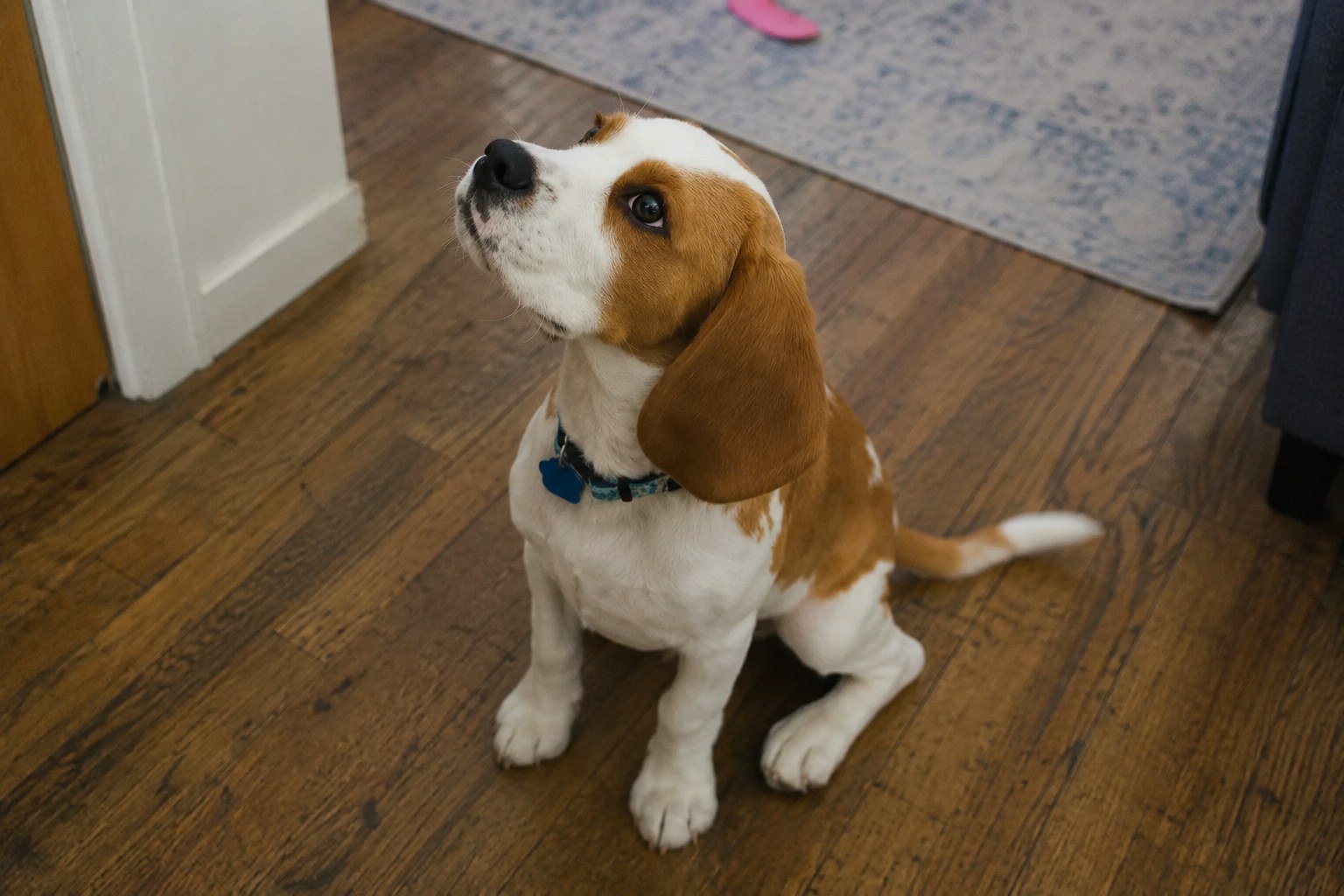
Nobody warns you about the stairs. You bring home a tiny puppy, you read that house-training is about "getting them outside quickly," and then you realize that outside is three flights down, past a neighbor's door, through a shared hallway, and onto a sidewalk — and your puppy has a bladder the size of a grape and roughly no warning system. By the time you've got the leash on and made it to the landing, the job is already done. On your rug. Again.
If you're house-training a puppy in an apartment, you are playing this game on hard mode, and it is not your fault. The good news: puppies house-train beautifully when the setup is right, and none of it requires scaring or scolding your dog. It requires a schedule, a little management, and catching the wins. This is how a Boston trainer actually does it, stairs and all.
Every accident inside is a rep of the wrong habit. Every success outside is a rep of the right one. House-training is just stacking the second kind faster than the first.
Which means your real job is management — not correction.
First, how house-training really works
Puppies aren't born knowing that grass is a toilet and carpet isn't. What they do have is a natural instinct not to soil the spot where they sleep and eat. House-training is simply the process of gently expanding that clean "den" instinct outward — from the crate, to the room, to the whole apartment — while making very sure that going in the right place, outside, is the most rewarding thing that happens all day.
That means the entire method rests on two levers, and only two: prevent accidents inside so the wrong habit never gets rehearsed, and richly reward success outside so the right habit takes root fast. Everything below is just those two ideas applied to apartment life. There is no punishment lever. There doesn't need to be one, and reaching for it actively slows the whole thing down — more on that near the end.
The schedule is the whole thing
Young puppies can hold their bladder for roughly one hour per month of age, and even that only when they're resting. An eight-week-old puppy who has just woken up, eaten, or played does not have an hour — he has about ninety seconds. So you don't wait for him to signal that he needs to go, because by the time he signals, in an apartment, it's already too late. You take him out before he needs to, on a clock.
Take your puppy out to the same spot:
The moment he wakes up — every single time, including the 2am one. A sleeping puppy who stirs is a puppy who is about to need to go.
A few minutes after every meal and every drink. Eating and drinking trigger the plumbing on a short timer; feeding on a set schedule makes the output predictable too.
After every play session and every bit of excitement — a visitor arriving, a wrestle with a toy, a burst of the zoomies.
On a regular interval in between — roughly every hour for a young puppy, stretching out as he grows.
Right before bed, and right before you leave him.
Yes, it's a lot of trips. For the first couple of weeks the schedule is the job, and it's exhausting, and it's temporary. Write it on a whiteboard, set phone alarms, split the trips with your partner or roommate. The families who get this done in a few clean weeks are almost always the ones who front-loaded the effort here rather than spreading a half-hearted version over two frustrating months.
The apartment "walk-down" problem — and the fix
Here's the trap unique to apartment living. In a house with a yard, you open a door and the puppy is on grass in three seconds. In a third-floor walk-up, the trip to the toilet takes long enough that your puppy learns something you never intended: that he'll be relieving himself on the way, in the hallway or the lobby or the elevator, because that's genuinely as far as his body will make it.
So you shorten the distance to zero at the start. Carry him. For a young puppy, scoop him up the moment he wakes and carry him down the stairs and out to the spot, feet not touching the floor until he's where you want him. It feels absurd and it is completely worth it — you are buying yourself the seconds his bladder can't spare, and preventing the hallway from ever becoming a habit. As he grows and his control improves, you transition to walking him down on leash, briskly and without detours.
Pick one specific outdoor spot and use it every time. Puppies key off their own scent, so returning to the same patch of sidewalk tree-pit or curb strip is a giant hint that says "this is the place." Take him there on leash even if you have a yard-like courtyard, so that from day one the toilet is outside the building, not in any indoor overflow zone.
Reward the instant it happens — outside, every time
This is the step people underestimate, and it's the one that makes the difference between three weeks and three months. When your puppy finishes going in the right spot, you mark and reward it immediately — a happy word the second he's done, then a genuinely good treat, right there on the sidewalk, within two seconds.
Timing is everything. A treat handed out back inside the apartment rewards coming inside, not eliminating outside — your puppy can't bridge the gap. The reward has to land while he's still standing over the evidence, so the lesson is crystal clear: going here, outdoors, makes wonderful things rain from the sky. Bring the treats out with you every trip. Make peeing outside the best-paid job your puppy has. Do that consistently and he will start actively wanting to get out there, which is exactly the motivation you're building.
When you can't watch him: manage, don't gamble
Between scheduled trips, a puppy who has the run of the apartment will find a quiet corner and go, and now you've got an accident and a rehearsed habit. So when you can't give him your eyes, you manage the space:
Tether or supervise closely when he's loose — puppy on a leash attached to you, or in the same small room, so nothing happens without you seeing it.
Use a crate or a small pen for short stretches when you genuinely can't watch. A puppy won't usually soil a properly sized sleeping space, which buys you a clean gap — this only works with a crate he already likes and that's sized so he can't use one end as a bathroom. Crate time is capped by that one-hour-per-month rule; it is not a way to leave a young puppy alone all day.
Watch for the pre-go signals — sudden sniffing and circling, drifting away from play, heading toward a previous accident spot. See any of that, scoop and go, right now.
Teaching your puppy to genuinely learn to settle between trips — to rest quietly rather than roam and rehearse — does double duty here: a calm puppy in a defined space is a puppy who isn't quietly christening your bedroom.
A word on pee pads (mostly: skip them)
Apartment dwellers are constantly told to use pee pads, and I'd gently steer you away from them for a puppy you intend to be fully outdoor-trained. A pad teaches your puppy that going indoors, on a soft absorbent surface, is correct — and then you have to un-teach that later, which is harder than teaching it right the first time. A soft absorbent surface also describes your bath mat, your rug, and your duvet.
There are real exceptions — a very young puppy alone longer than his bladder allows, a genuine medical situation, a high-rise where the ground is many minutes away. If you truly need one, treat it as temporary scaffolding to phase out, place it as far from his sleeping and eating area as the space allows, and understand you're accepting a slower path to fully outdoor. For most Boston apartments with stair access, the carry-down method beats a pad.
Accidents happen — here's what to actually do
You will have accidents. Every puppy does. What you do in that moment matters more than the accident itself.
If you catch him mid-stream: interrupt gently — a light clap or a cheerful "oops, outside!" — enough to pause him, not to frighten him, then hustle him out to finish and reward the finish. You're redirecting, not punishing.
If you find it after the fact: say nothing, clean it up, and quietly resolve to tighten the schedule. Your puppy cannot connect a scolding now to something he did ten minutes ago — the old "rub his nose in it" advice is not only useless, it teaches him that you are unpredictable and that going in front of you is dangerous, so he starts hiding it. That's how you end up with a dog who sneaks off behind the couch.
Clean with an enzymatic cleaner, not a regular household one. Puppies return to spots that smell like a toilet, and ordinary cleaners leave scent markers a dog's nose reads clearly even when yours can't. Enzyme cleaners actually break the odor down.
Why apartments make this harder — and why that's normal
If this feels harder than the breezy advice online suggested, it's because it is, and the geography is the reason. Shared hallways mean a mess isn't just yours to clean — it's a neighbor and a landlord issue too. Stairs and elevators add minutes a puppy's bladder doesn't have. And thin-walled triple-deckers across Cambridge, Somerville, and Brookline mean a puppy crated for a legitimate clean break can't always be left to fuss for even a few minutes without an audience downstairs.
None of that means you're doing it wrong or that your dog is slow. It means you're solving a normal city problem that thousands of good owners around you are solving too — often while juggling the other puppy problems landing on you at the same time. Adjust the plan to the building, keep the reps clean, and it comes together.
The bottom line
House-training an apartment puppy isn't about willpower or catching your dog in the act — it's about a tight schedule, shrinking the walk-down so accidents can't happen in the hallway, and paying generously for every success outside. Prevent the wrong reps, reward the right ones, skip the punishment and usually the pee pads, and be patient through the inevitable setbacks. A few weeks of real effort up front buys you a clean-in-the-house dog for life.
If you've got a new puppy and the stairs-and-schedule juggle is wearing you down — or you're hitting the same accident spot over and over and can't work out why — we'd genuinely love to help. Reach out for a training consult and let's build a house-training plan that fits your puppy and your Boston apartment.
Struggling with this at home?
Every dog is different, and some problems are hard to solve from a blog post. Tell us what is going on and we will talk through where to start — free, no pressure, no pitch.