
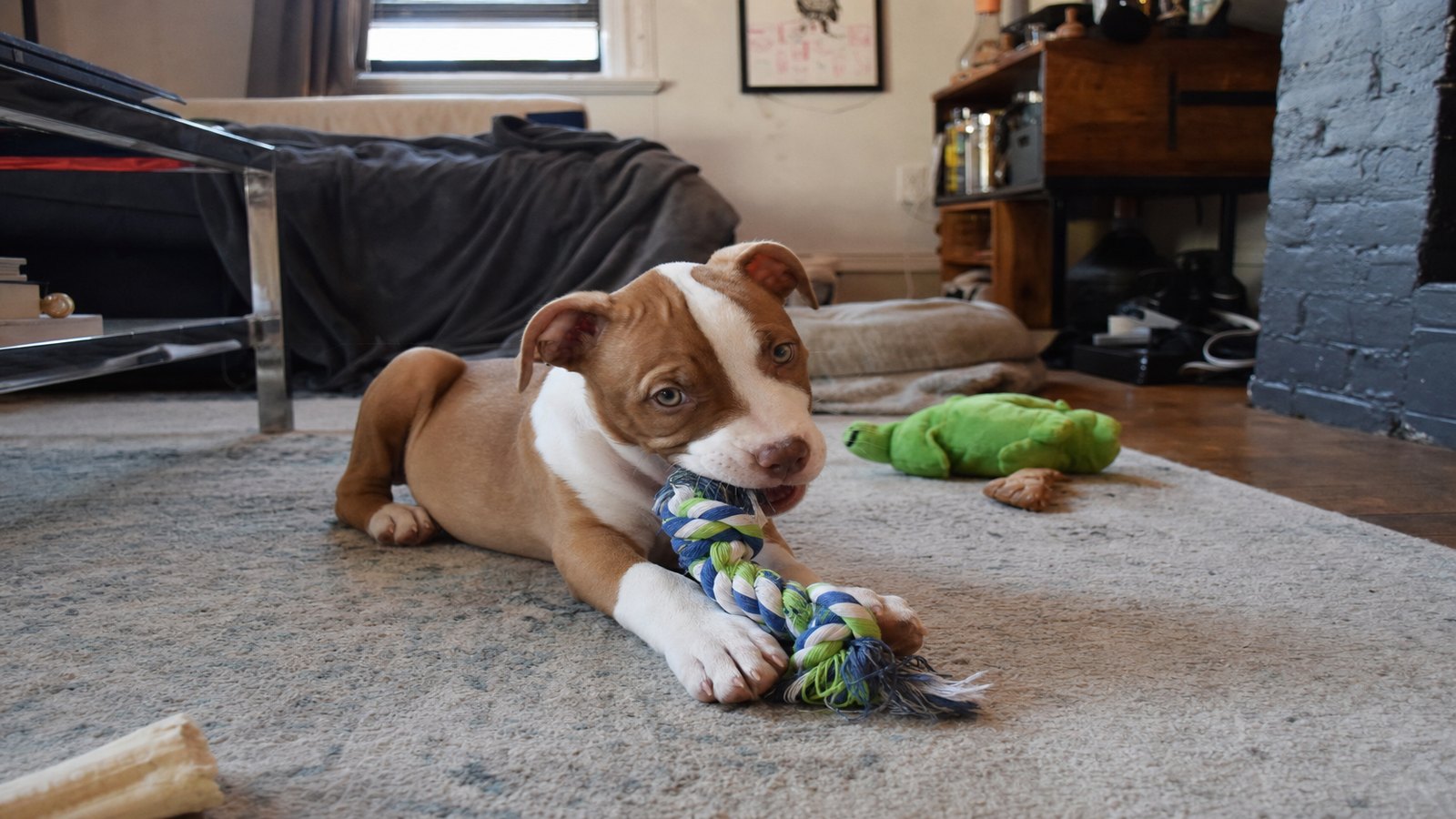
You brought home this small, soft, wonderful creature, and within about a day you discovered that it is also a set of tiny razor blades. Your puppy bites your hands when you pet him. He grabs your sleeves, your pant legs, your kids' hair. Every time you reach down he latches on, and the harder you pull away the more it turns into a game. Your forearms look like you lost a fight with a rosebush, and somewhere in the back of your mind a quiet worry has started: is this normal, or is something wrong with my dog?
Here's the reassurance first, because you need it: this is completely normal, it does not mean your puppy is aggressive, and it is one of the most fixable things a young dog does. Puppy biting — trainers call it "mouthing" — is how puppies explore the world and play with each other, and your puppy is doing it to you because he thinks of you as family, not because he's mean. The goal isn't to punish it out of him. It's to teach him, kindly and consistently, that human skin is delicate and that there are far better things to put those teeth on.
Your puppy isn't biting because he's bad. He's biting because he's a baby with no hands and a mouth full of new teeth.
The job is to teach, not to punish.
Why puppies bite in the first place
A puppy's mouth is his hands. He has no other way to grab, test, and investigate the world, so everything goes in there — your fingers, the rug, a shoe, the leg of a chair. On top of that, from around three to six months he's teething: adult teeth are pushing through sore gums, and chewing genuinely feels good on them, the way a cold spoon feels good on a bruise.
And then there's play. Puppies play with their littermates almost entirely by wrestling and mouthing, and when you took your puppy home you became his new littermate. So he plays with you the only way he knows how. None of this is aggression — it's a baby animal doing exactly what baby animals are built to do. Understanding that changes how you respond, because you're not stamping out a bad dog; you're teaching a normal one a new set of rules.
The golden rule: redirect, don't punish
The single most important thing to get right is what you do not do. It is very tempting, when a puppy sinks his teeth into you, to grab his muzzle, hold his mouth shut, pin him down, or shout. Please don't. Those methods backfire in predictable ways: some puppies find the rough handling exciting and bite harder, and some learn that hands coming toward them are scary, which plants the seed of exactly the fear-based problem you don't want down the line.
Reward-based training does the opposite. Every time your puppy is about to make a bad choice with his mouth, you make it easy for him to make a good one instead, and then you pay him for it. Over and over, in small ordinary moments, he learns that teeth-on-skin ends the fun and teeth-on-toy keeps it going. That's the whole engine. It's not dramatic, and it doesn't work in a day — but it works, and it builds trust instead of spending it.
Teach him that skin is delicate: bite inhibition
Puppies learn "how hard is too hard" from their littermates. When one puppy bites another too hard in play, the bitten puppy yelps and the game stops — and the biter learns to soften his mouth. You can stand in for that lesson.
Let a too-hard bite end the game. When those needle teeth catch your skin harder than a feather, give a short, calm "ow" or "ouch" — not a scream, just a clear marker — then quietly stand up, fold your arms, and stop playing for ten or fifteen seconds. No talking, no eye contact, no wrestling. The message lands fast: hard teeth make the fun person turn into a boring statue.
Restart calmly. After a few seconds, go back to interacting. You're not banishing him — you're showing him a switch he controls. Bite soft, game continues. Bite hard, game pauses.
Reward the soft mouth. When he takes a treat gently, or mouths your hand without pressure, tell him he's good. You want him to notice that gentleness pays, not just that roughness stops.
The aim over a few weeks isn't zero mouthing overnight — it's a puppy who first learns to bite softly, and then learns not to bite skin at all. A dog who learned as a puppy that human skin is delicate is a safer dog for his entire life, which is why this step is worth the patience.
Always have a "yes" ready
Telling a puppy "no teeth on me" only works if you're also telling him "yes, teeth here." A puppy with sore gums and nothing to chew will chew you, or your couch, by default. So the house rule is: there is always something legal within reach.
Keep a chew toy in every room your puppy hangs out in — by the couch, near the door, in the kitchen. The moment he starts to get mouthy with you, calmly offer the toy instead of your hand and make it move like something alive; a still toy is boring, a wiggled one is prey. When he grabs it, that's the win — praise it. For teething specifically, a wet washcloth twisted and frozen, or a rubber toy chilled in the freezer, feels wonderful on those gums and gives him a reason to seek out the right thing when the sore-gum urge hits.
Redirecting works far better than correcting, because it answers the question the puppy is actually asking. He doesn't want to hurt you — he wants something to chew. Give him a better answer and he'll take it.
The overtired puppy: the witching hour
Here's the secret almost every new owner misses. The absolute worst biting — the frantic, land-shark, "he's possessed" biting that usually shows up in the early evening — is very often not a training problem at all. It's an overtired puppy who cannot switch himself off.
Puppies need an enormous amount of sleep, sixteen to eighteen hours a day, and a puppy who's overtired gets wired and bitey exactly the way an overtired toddler melts down. When your puppy hits that manic, teeth-everywhere state, the answer usually isn't more correction — it's a nap. Guide him gently to his crate or a quiet pen with a chew and let him crash. Nine times out of ten the little crocodile is asleep within minutes, and you'll realize the "behavior problem" was a bedtime problem.
Teaching a puppy to settle himself is a skill in its own right, and it's a close cousin of a real off switch — the same calm-on-a-mat habit that makes the rest of life with a dog easier. Build the nap routine early and the evening biting often fades on its own.
Puppy realities in Cambridge and Somerville
Raising a bitey puppy in a dense city apartment has its own wrinkles, and it's worth naming them.
Less room to burn energy. A puppy in a Cambridge apartment can't just be let out into a yard to tire himself out, so pent-up energy comes out as mouthing indoors. Short, frequent bursts of play and sniffing — plus puppy-appropriate walks once he's vaccinated — take the edge off before the teeth come out.
Kids and small spaces. In a small Somerville apartment there's nowhere for a child to escape a nipping puppy, and running away only turns the kid into a squeaky, fast-moving toy. Teach kids to "be a tree" — stand still, arms in — and keep a toy in every room so an adult can redirect fast. Never leave a young child and a mouthy puppy loose together unsupervised.
Excitement at the door. The same overexcited puppy who launches at guests often bites in the same moment, and city apartments funnel everyone into one tight entryway. A chew station away from the door helps, especially when the buzzer goes and everyone's energy spikes.
Neighbors and thin walls. A yelping-and-pausing game is fine, but a puppy who's genuinely losing it at 8 p.m. in a triple-decker is a nap problem, not a volume problem — and the nap fixes the noise too.
What quietly makes puppy biting worse
Yanking your hand away fast. A jerking hand looks exactly like fleeing prey and cranks the biting up. Go still and boring instead, then redirect.
Rough, hands-on "corrections." Muzzle grabs, mouth-holding, and pinning teach a puppy that hands are threats. That's how you trade a normal biting phase for a fear problem.
Wrestling with your hands. If you use your fingers as a toy, you're literally training your puppy that hands are for biting. Use a toy as the buffer, every time.
No legal chew nearby. A puppy with sore gums and nothing to chew will always default to you or the furniture. Stock every room.
Letting an overtired puppy "play it off." He can't. More stimulation makes the land-shark worse. Read the manic phase as tired and offer a nap.
Troubleshooting
He bites harder when I say "ow." Some puppies find a high-pitched yelp exciting rather than sobering. Drop the sound and just go silent and still, or calmly step behind a baby gate for a few seconds so the fun truly stops.
He grabs my kids' hands and clothes constantly. Kids move fast and squeal, which is irresistible to a puppy. Manage first — gates, pens, a toy in every room — and coach the kids to freeze rather than run. Adults do the redirecting until the puppy's older.
He only turns into a monster in the evening. Classic overtired witching hour. Build a real nap into late afternoon and settle him before he tips over the edge, rather than trying to train through the meltdown.
The mouthing isn't stopping as he gets older. Past four or five months, mouthing that isn't fading — or that comes with stiffness, growling over food or toys, or a hard, fixed stare — is worth having a professional look at in person, because that's a different conversation from normal puppy teeth.
When to bring in help
Most puppies grow out of biting within a few weeks to a couple of months of calm, consistent redirecting, and one day you'll realize the needle teeth are just... gone. But some puppies make it genuinely hard — the ones who escalate instead of settling, the ones biting kids in a small apartment where there's nowhere to create space, the ones where you're not sure anymore whether it's ordinary mouthing or something that needs a closer look. Those are exactly the cases where an experienced set of eyes on your puppy, in your actual home, saves you weeks of second-guessing.
Good Dog Boston trains in your home, in the exact space where your puppy is struggling, using reward-based methods as our primary approach. We take on the dogs plenty of places turn away, and we have Spanish-speaking trainers available. If you're worn down by a puppy who treats your hands like chew toys, or you've got kids and a small apartment and you need a plan that actually fits your life, having a trainer build the habits with you — in your own space, on your own schedule — is worth more than any amount of reading.
If you'd like a hand, book a free evaluation call and we'll talk through what's going on and where to start. No pressure, no pitch — just a plan.
Struggling with this at home?
Every dog is different, and some problems are hard to solve from a blog post. Tell us what is going on and we will talk through where to start — free, no pressure, no pitch.