
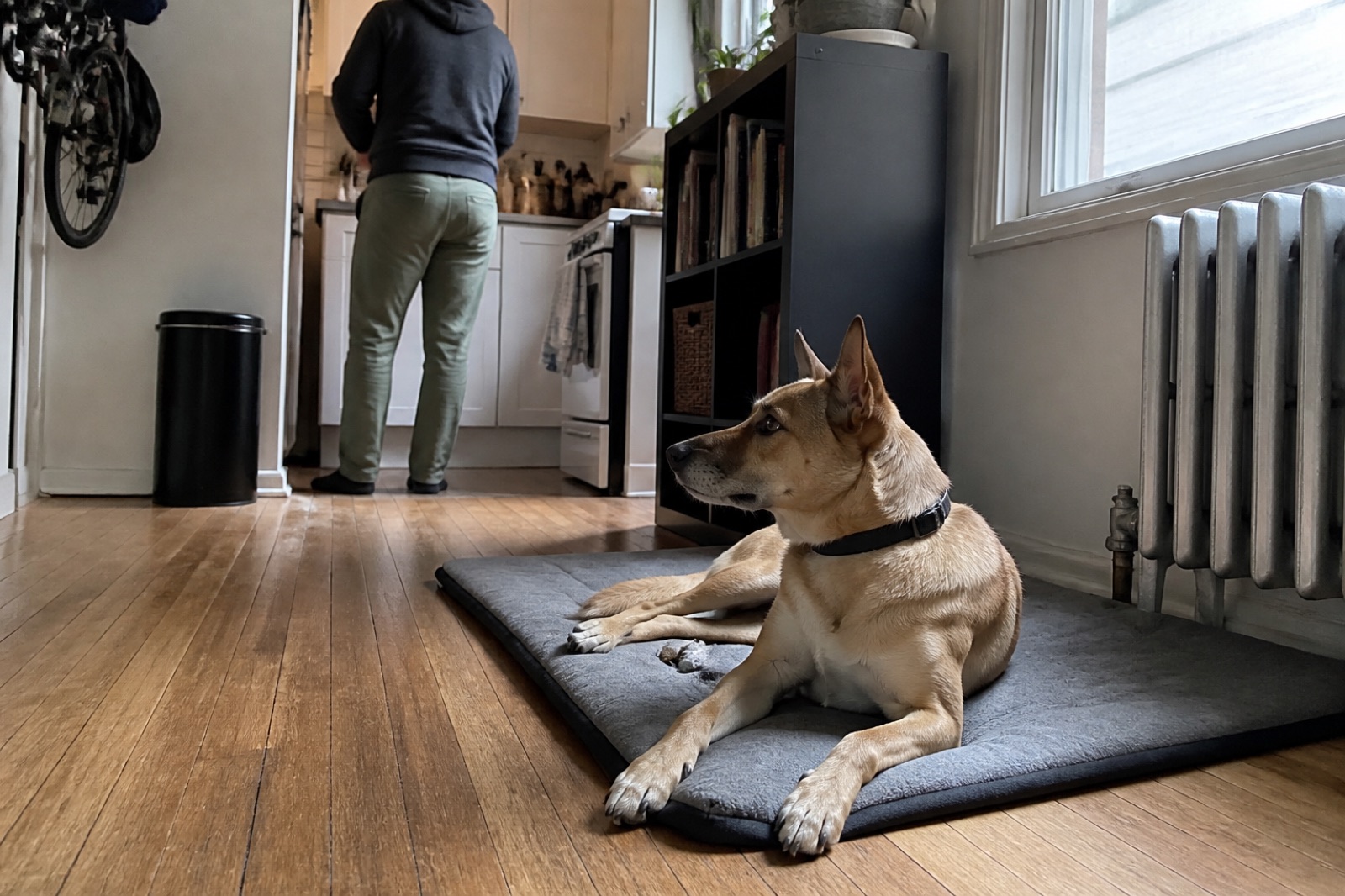
It's six o'clock, you're trying to get dinner on, and your dog will not leave you alone. He's underfoot at the stove, then he's dropped a slobbery tennis ball on your foot, then he's pacing a lap of the kitchen and whining at the fridge, then he's back with the ball. You've thrown it four times just to buy ninety seconds of quiet. When you finally sit down to eat, he's leaning his whole body against your chair, staring, sighing, willing a piece of chicken into existence. He's not a bad dog. He just seems to have no idea how to do nothing — no off switch, no default setting that isn't "on."
If your evenings, your work-from-home calls, and your attempts to read a book on the couch all come with a restless shadow, this post is for you. The skill your dog is missing is called settling, and the tool that teaches it is a mat and a word — usually "place." A dog who can go to a spot and genuinely relax on cue is a different animal to live with. This isn't about a rigid down-stay you have to police every second. It's about building a real off switch, so your dog learns that lying quietly on his bed is its own reward, and that the busy household swirling around him is nothing he has to manage.
Why your dog can't switch off
Most dogs who can't settle were never taught how. We spend a lot of energy teaching dogs to do things — sit, come, fetch, shake — and almost none teaching them to do nothing on purpose. So the dog fills the vacuum himself, usually with the behaviors that have worked before: pacing, pestering, dropping toys, staring you down. Every one of those has probably paid out at some point. You threw the ball. You got up. You gave him a bite to stop the staring. From his side of the room, restlessness is a strategy with a solid track record.
There's also arousal to reckon with. A dog who spends his day oscillating between hard exercise, exciting greetings, and being wound up by the doorbell never practices the middle gear. Calm is a physical state, and like any state it gets stronger with repetition. A dog who rarely rehearses relaxation genuinely struggles to find it — his baseline creeps upward until "keyed up" becomes his normal. The fix is to make calm a thing he practices every single day until it's the easy, well-worn groove instead of the road he never takes.
The good news: settling is teachable the same plain way you'd teach a sit. You mark and pay the calm you want, you build duration slowly, and you give it a name. Do it consistently and you end up with a dog who, when the house gets busy, drifts to his mat and lies down because that has become the most rewarding thing to do.
Build the mat first: make calm the thing that pays
Start with a defined spot — a dog bed, a folded blanket, a mat — somewhere in the room where the family actually lives, not banished off in a back bedroom. The whole point is a dog who relaxes near you while life goes on, so put the bed in the corner of the kitchen or at the edge of the living room.
Now teach the bed the boring, brilliant way:
Pay every visit to the mat. Any time your dog steps onto the bed, calmly mark the moment — a quiet "yes" or "good" — and drop a treat right onto the mat. Say nothing else. Off the mat, nothing happens; on the mat, food appears from the sky. Most dogs start deliberately parking themselves there inside one session, testing whether the magic still works. It does.
Pay the down, then pay staying down. Once he's offering the mat, wait for him to lie down and pay that more generously. Then start a slow trickle — one treat every few seconds, dropped between his paws, just for lying there. You're teaching the single most important lesson: on the mat, calm gets paid on repeat, for doing absolutely nothing.
Give it a name. When he's heading to the bed reliably, name it — "place," "bed," "mat," "spot," whatever you'll actually remember when you're stressed and stirring a pot. Now you have a cue that means one thing: go there and settle.
Spend a few days just here, in a calm room with nothing else going on. A mat behavior built in quiet is the foundation; everything harder bolts onto it later.
Pay real relaxation, not just a body on the bed
Here's the piece people miss, and it's what separates a genuine off switch from a dog vibrating with tension on his mat, waiting to be released like a coiled spring. You want to reward relaxation itself, not just the position.
So as your dog holds the mat, start watching for and paying the physical signs that he's actually letting go: a hip rolled to one side instead of a tense sphinx-down, a chin lowered to the floor, a long sigh, ears softening, the weight visibly coming off his shoulders. When you see one of those, mark it quietly and deliver the treat slowly and calmly, right between his paws — no tossing, no excited voice, nothing that spikes him back up. You are literally rewarding his nervous system for downshifting. Do this enough and your dog learns that the fastest way to earn food on the mat is to genuinely relax, so he starts offering calm on purpose. Many owners describe the moment it clicks: the dog flops onto his hip, exhales, and settles into a real rest instead of a held position.
Keep your own energy low the whole time. Calm is contagious in both directions — if you're brisk and chatty, you'll keep him on the boil. Move slowly, talk little, and let the quiet do the teaching.
Add duration, then add the busy house
Once your dog will lie on the mat and soften, stretch the time. Feed a little less often — every five seconds, then every ten, then only now and then — so he learns to hold the settle without a constant paycheck. Potter around the room. Sit down with your coffee. Read. You're teaching that "place" doesn't mean a frantic thirty-second trick; it means stay here and relax until I say otherwise.
Then, and only once the calm is solid, start bringing the real household to him — one distraction at a time, kept easy at first:
Cue "place," then cook. Put him on the mat and go about making dinner. Step back and pay the settle every so often at first, then less. If he breaks, no drama — just guide him back and lower your difficulty for a rep or two.
Cue "place" during a work call. A stuffed chew or a frozen food toy on the mat turns a settle into an easy win and buys you a solid meeting.
Cue "place" when the family swirls. Kids doing homework, the TV on, someone unloading groceries. The dog's job stays the same: hold the mat, stay soft, get paid for calm amid the chaos.
Always end the settle on your terms with a clear release word — "okay," "free," "all done" — followed by a warm bit of praise. The release matters as much as the settle: it tells your dog that leaving the mat is your call, not something he negotiates by pacing or whining.
Where this pays off everywhere else
A dog with a real settle is easier to live with in every direction, because "go relax on your spot" becomes your answer to a dozen daily situations. It's the calm foundation under the doorbell meltdown — a dog who can settle on a mat has somewhere to be when the bell rings, instead of launching at the door. It takes the edge off a dog who's used to greeting every guest like a springboard, because now he has a job that isn't jumping. And it's the same steady calm you want on a walk — a settled dog on his mat and a loose-leash dog on the sidewalk are running the same software: the world is exciting, and the answer is to stay relaxed and get paid.
Practically, the settle is what lets you take your dog places. A dog who can hold a relaxed down under a cafe table, at a friend's kitchen, or at the vet's waiting room is welcome in a lot more of your life than a dog who can't stop spinning.
A few things that quietly sabotage it
Only ever using "place" as a punishment. If the mat is only where the dog gets sent when he's in trouble, he'll learn to dread it. Pay it richly and often when nothing's wrong, so it stays a good place to be.
Rewarding with big excited energy. A high-pitched "GOOD BOY!" and a tossed treat spikes your dog right back off the mat. Keep the marker quiet and the delivery slow.
Skipping the exercise and expecting stillness. Settling is a skill, not a substitute for a tired dog. A dog who's had a real sniffy walk and some engagement settles far more easily than one who's been cooped up all day with energy to burn.
Never releasing him. If you always just wander off and let the settle dissolve on its own, the word loses its edges. Use a clear release every time so "place" has a defined start and finish.
Going too fast into hard. Cooking a full dinner is a graduate exam. If your dog can't yet hold the mat while you make a sandwich, he can't hold it through Thanksgiving. Build the difficulty in slices.
Troubleshooting
He pops off the mat the second I stop feeding. You stretched the time too fast. Go back to paying more often, then thin it out in smaller steps. Duration is its own skill and it grows slowly.
He lies on the mat but he's rigid, staring, ready to spring. You're paying the position but not the relaxation. Slow everything down, wait for a real sign of letting go — a hip roll, a sigh — and pay that, not just the down.
He whines or barks on the mat. Try not to reward it by releasing or feeding into the noise. Pay the quiet gaps instead, and check you haven't jumped to a distraction that's too hard for where he is.
He'll settle in the living room but falls apart in the kitchen at dinnertime. The kitchen at six o'clock is the hardest room in the house — smells, movement, the history of dropped food. Treat it as advanced. Practice there at an off-hour first, with nothing cooking, before you ask for a settle mid-dinner.
Where to practice in Cambridge and Somerville
Most of the settle gets built at home, where the mat lives. But proofing it out in the world is what makes it bombproof — a dog who can relax amid real distraction can relax through anything your evening throws at him.
Easy — your own living room. The mat drills and the first duration work belong here, on a quiet weekday. The busy corners of a Somerville apartment — the kitchen at dinnertime, the front room while the TV's on — are the natural next step once the calm holds.
Medium — a bench in Union Square or the edge of Cambridge Common. Bring the mat or just a towel, cue a settle, and pay calm while ordinary foot traffic passes at a workable distance. You're teaching that a busy scene doesn't mean he has to do anything about it.
Medium-plus — a quiet stretch of Fresh Pond Reservation or the paths along Memorial Drive. More movement, more dogs and joggers, still enough room to reset before he tips over threshold. Magazine Beach on a slow afternoon works the same way.
Advanced — a Davis Square patio on an unhurried afternoon. Save this for when the settle is genuinely solid. A dog who can hold a relaxed down while the whole square walks by has an off switch you can trust at home.
Everywhere you practice, you're teaching one idea: the world is busy, and your dog's job is simply to settle and be paid for it — the same message his mat carries back home in the kitchen.
When to bring in help
Plenty of dogs learn a solid settle in a few weeks of calm, boring reps. Some make it genuinely hard — dogs whose engine idles high and truly can't find the middle gear, adolescents in the thick of their over-the-top phase, rescues who never learned that a home can be a place to relax, or dogs whose restlessness is tangled up with real anxiety rather than simple habit. Those are the cases where an experienced set of eyes on your dog, in your actual living room, saves you weeks of guessing which piece to fix first.
Good Dog Boston trains in your home, in the exact rooms where your dog struggles to switch off, using reward-based methods as our primary approach. We take on the dogs plenty of places turn away, and we have Spanish-speaking trainers available. If you're worn down by a dog who never seems to rest, having a trainer build a real settle with you — at your own kitchen, at your own dinnertime — is worth more than any amount of reading.
If you'd like a hand, book a free evaluation call and we'll talk through what's going on and where to start. No pressure, no pitch — just a plan.
Struggling with this at home?
Every dog is different, and some problems are hard to solve from a blog post. Tell us what is going on and we will talk through where to start — free, no pressure, no pitch.